If you've spent any time looking at antique handsaws — at an estate sale, in an antique store, or scrolling eBay at midnight — you've seen Disstons. A lot of them. Disston was the largest saw manufacturer in the world for most of a century, and they made an enormous number of saws. That's good news for anyone trying to buy one: there are plenty out there, and you don't need to pay a fortune for a great user.
But "plenty of Disstons" also means plenty of beat-up Disstons, plenty of mis-dated Disstons, and plenty of sellers asking too much because the saw says "Disston" on the medallion. This guide is meant to help you sort through what you're looking at and decide whether a particular saw is worth your money.
A quick note before we start. For comprehensive scholarly reference on Disston saws — exhaustive medallion variations, complete model histories, catalog reproductions, articles from Disston publications — the Disstonian Institute, maintained by Erik von Sneidern, is the definitive source. It has been the standard reference for over twenty years. This guide isn't trying to replace it. The Disstonian Institute answers "what exactly is this saw?" This guide is meant to answer a different question: "I'm looking at a Disston — is it worth buying, what do I need to look for, and what's the difference between a good one and a project that'll fight me?"
If you haven't already, you may also want to read A Practical Guide to Buying Antique Handsaws for general advice on inspecting any antique saw. This guide builds on that one and gets specific about Disston.

A brief Disston history
Henry Disston started making saws in a rented Philadelphia basement in 1840. He had a hard first decade — there were fires, and at one point his machinery was confiscated in a rent dispute — but by the time of theCivil War, Disston had become the dominant American saw manufacturer. By the late 1800s, Disston was the largest saw maker in the world, producing not just handsaws but circular saws, two-man saws, files, and an enormous variety of other tools. The company stayed in family hands for three generations after Henry's death in 1878, and the quality stayed high through most of that run.
What this means for you as a buyer: any Disston saw from roughly 1850 to 1928 was made when the company was at or near its peak. That's a long window. There are some real differences within it — handles got plainer over time, etches changed, models came and went — but a clean, well-tuned Disston from any year in that range will cut wood as well as a high-end new saw and will look a lot better than most new big-box-store saws.
After 1928, things slowly changed. Henry Disston and Sons was sold to H.K. Porter in 1955, and the saws made under the Porter ownership are generally considered the end of the line for quality. There are still good user saws from the 1940s and into the early 1950s, but I'd usually pass on anything that's clearly post-1955 unless it's cheap.
Dating a Disston by its medallion
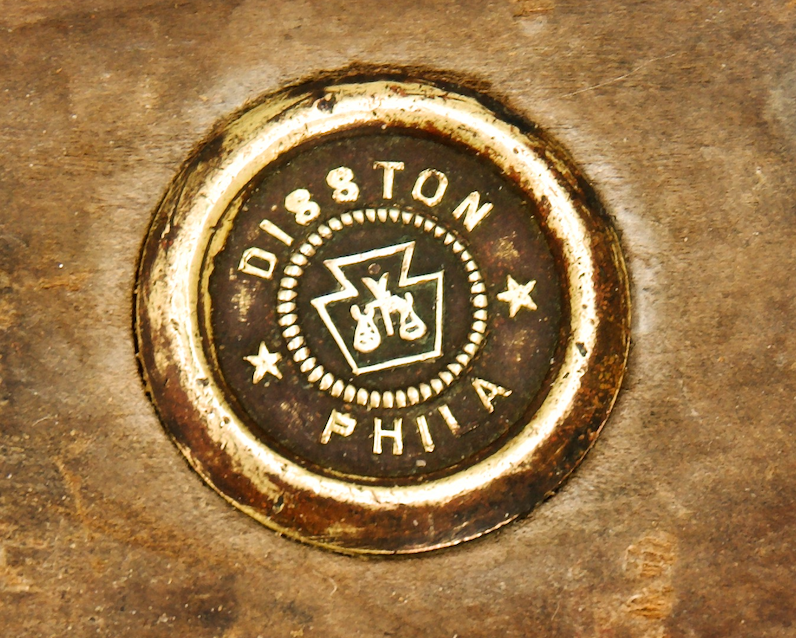
1917 - 1940
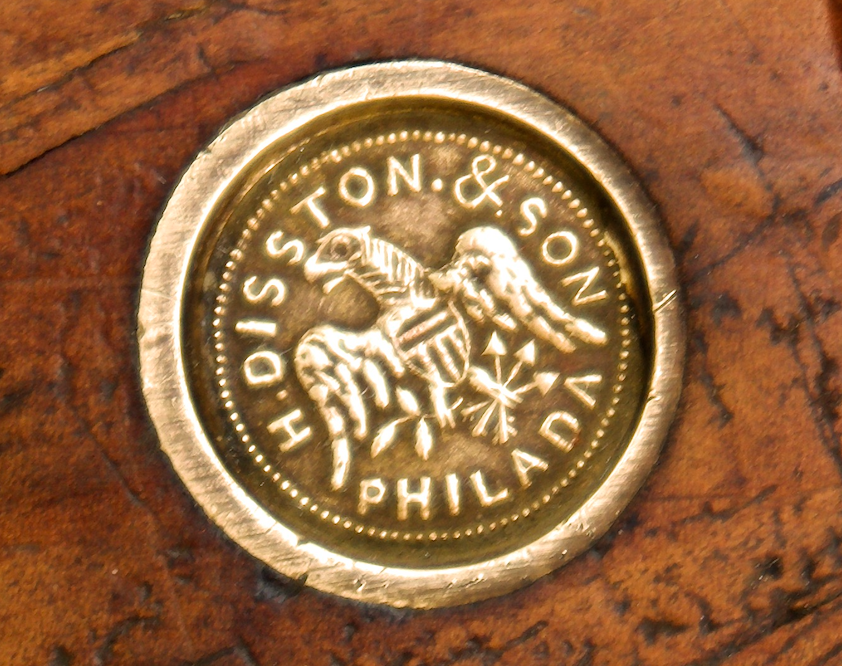
One Son - 1865 - 1871
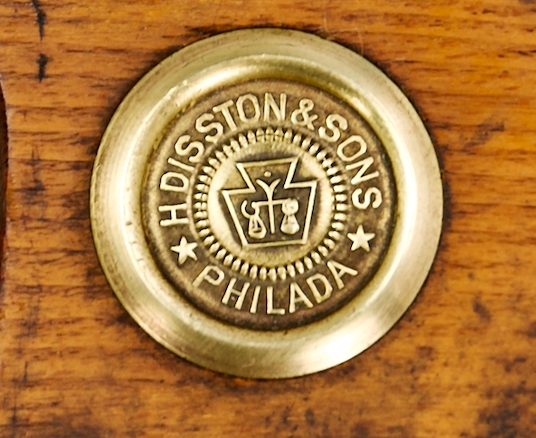
late 1800s/early 1900s
The medallion — the round brass disk at the top of the handle — is the easiest way to date a Disston. Disston changed the medallion design regularly for over a hundred years, and each change is well-documented. If you can see the medallion clearly, you can usually narrow the saw's age down to a narrow window without much trouble.
I'm going to give you a working overview of the main medallion eras here, but if you want to identify a specific medallion in detail, the Disstonian Institute's medallion guide is the place to do it. Erik has photographed and dated more variants than I ever will, and it's the right tool for precise identification.
For practical buying decisions, here are the eras that matter most:
No medallion saws are some of the rarest of the rare. Henry Disston made saws before he started using medallions. If you find one of these, share a picture of it online. The saw nerds out there will oooo and ahhh over it.
Pre-1865 medallions are uncommon and tend to attract collector interest. If you find an "eagle-in-flight" medallion (mid-1840s) or a federal-style or Aztec-style eagle (late 1840s through early 1860s), the saw is probably a collector's piece more than a user. They can still be excellent cutters, but the price is usually set by collectors.
1865–1876 medallions read "Henry Disston & Son" (one son, 1865–71) or "Henry Disston & Sons" (two sons, 1871–75) and then drop "Henry" entirely starting in 1876. These are still desirable to collectors, but you'll see them more often, and a clean-but-not-rare example can still be a good user buy.
1876–1896 medallions are the "Disston & Sons" medallion, with or without Glover's 1887 patent date. This is the start of the era where Disstons get common enough that a nice example is realistically affordable for someone who just wants to use the saw.
1896–1917 medallions are the most common medallion era you'll encounter in the wild — the saws are everywhere, the quality is excellent, and prices are reasonable. If you're looking for a daily-use Disston, this era is the sweet spot.
1917–1928 medallions are also common and still very good user saws. The handles started to get a little plainer around this period, but are otherwise as good as previous eras.
1928–1940 medallions are still genuinely good saws, but you'll start seeing more variation in handle quality and detail.
Post-1940 medallions include the 1940–47, 1947–53, and 1953–55 styles. There are still good saws in this range, but inspect them carefully. By the late 1950s, quality had clearly declined.
A small but important warning: medallions can be swapped. If a handle looks much older than the medallion would suggest (or vice versa), somebody may have replaced the medallion at some point. This isn't necessarily a deal-breaker, but the saw is no longer accurately dated by the medallion alone. Look at the etch (if it's still readable) and the handle style to see if the story holds together.
Major Disston handsaw models worth knowing
Disston made dozens of models over the years, and the Disstonian Institute's model pages cover every variant in detail. For a practical buyer, here are the ones you're most likely to see and most likely to want.
No. 7 / D-7. A solid mid-grade handsaw. The No. 7 was made from the 1870s; the D-7 was the post-1928 version. Comfortable handle, applewood on earlier models. Excellent user saw. Often more affordable than the higher-grade saws because collectors don't chase them as hard.
No. 8 / D-8. Disston's most popular model for most of the late 19th and early 20th centuries. D-8s are everywhere. A clean No. 8 or D-8 is one of the easiest "great Disston" purchases you can make. No. 8s are identical to No. 7s but have an apple handle instead of a beech handle. No. 8s are very uncommon.
No. 12 / D-12. A premium-grade model, with a higher-grade handle and apple wood on earlier versions. The No. 12 is often considered the best user handsaw Disston ever made. They cost more than a No. 7 or No. 8 — both originally and today — but they're worth it if you find one in good shape.
D-23. A common mid-20th-century saw. Plainer handle than the older models, but still a perfectly serviceable user if you find one cheap.
D-100. There are the same as D-8s. They just have a fancier wheat-carved handle.
Backsaws. Disston made a wide range of backsaws — carcase saws, tenon saws, dovetail saws. The No. 4 backsaw is the most common. Smaller dovetail saws (the No. 68 series) are highly sought after by hand-tool users today and often command premium prices.
I'm not going to try to list every model here because that's exactly where Disstonian Institute is the right reference. If you've identified a specific model and want to know its full history, look it up there.
What makes a Disston worth buying
This is the section that the reference sites don't really cover, because it's not their job. As someone who restores and sharpens these saws, here's what I look for:
Plate condition. The plate (the steel blade) is the heart of the saw. Surface rust cleans up. Light pitting is fine — a saw that's lived a hundred years is allowed to have some character. But deep pitting on the cutting edge, kinks that won't hammer out, or a plate that's been filed so many times there's almost nothing left are real problems. Sight down the back of the blade like you would check a board for straightness. A gentle bend can be corrected. A sharp kink or a plate that wanders in multiple directions is a much bigger job.
Etch survival. The etch is the design and text printed on the blade — usually the Disston eagle-and-keystone logo and the model name. Etches are surface-deep and they're often the first thing to go when a saw has been heavily cleaned or used hard. A saw with a strong, fully readable etch is more valuable than one without. But — and this is important — a saw with no visible etch is still a perfectly good user saw. The etch is cosmetic. Don't pass on a great-cutting Disston because the etch is gone, and don't pay a premium for a so-so saw just because the etch is bright.
Handle condition. Disston handles were apple wood on the earlier and higher-grade models, beech on later and lower-grade models. Both age well if they've been cared for. Look for cracks at the upper horn (the part that curls over the top of your hand) and at the lower horn (which sweeps under). Cracks and chips in the handle are common and can be repaired, but they affect value. Horns are often broken completely off. This can all be repaired or left as-is. Bigger problem: a handle that's been refinished with thick modern varnish or, worse, painted. That's expensive to undo and never quite right afterward.
Original hardware. The medallion and the split-nut or domed-nut saw screws should match the era. Mismatched hardware (a 1910 medallion on an 1880 handle, for example) means somebody has done work on the saw, which isn't necessarily bad but means you need to look at everything else carefully. Missing nuts are easy enough to replace, but they're missing for a reason and that reason is usually that somebody took the saw apart and didn't finish reassembly.
The handle-to-blade fit. Grab the handle and try to wiggle the blade. There should be essentially zero movement. If you can feel the blade flexing against the handle, the saw screws are loose or the wood has shrunk around them. Tightening the saw screws is easy if they cooperate, but if the wood is rotten or split where the screws attach, you have a bigger repair on your hands.
Common Disston condition issues
Most antique Disstons you'll encounter have at least one of these issues. Some are fine, some are deal-breakers:
Surface rust — fine. Cleans up with an abrasive and a little patience.
Light pitting — fine. Doesn't affect cutting.
Deep pitting on the cutting edge — bigger problem. If the pits go deep enough that they show in the tooth line, the teeth are likely to break off when filing or setting.
A gentle bend — fixable. Hammering a saw flat is a learnable skill, though not a quick one.
A sharp kink — usually a deal-breaker for a user. Possible to remove but very labor-intensive and not always successful.
A worn-down plate — happens when a saw has been jointed and sharpened many times over its life. The toothline ends up much closer to the back of the saw than it started. Still a usable saw, but it has less life left in it.
Cracked or broken off horns — repairable but affects value. Common on saws that have been dropped or stored badly.
Refinished handle — depends on the refinish. A handle stripped to bare wood and re-oiled is fine. A handle coated in shiny polyurethane is sad but the saw underneath is unchanged. A painted handle is the worst — strip it carefully and see what you've got.
Missing or broken teeth — can be retoothed, but it's not a beginner job. If you can't retooth yourself, factor in the cost of having a sharpener do it. I do retoothing as part of my saw sharpening service, and I'm not the only one, but it adds real cost to refurbishing the saw.
Replaced hardware or medallion — not a deal-breaker for a user, but it does mean the saw is no longer "correct" in collector terms. I'll admit that I think frankensaws have a lot of character. They also usually work just as well as an all-original saw.
A note on Warranted Superior medallions
You'll sometimes see Disston-made saws with a "Warranted Superior" medallion instead of the Disston medallion. These were Disston's lower-priced line, often sold under hardware-store private labels. They're typically excellent user saws — same steel, same handles, just sold under a different name. Don't pass on a Warranted Superior just because it isn't marked Disston. If you can confirm it's actually a Disston-made saw (the handle shape and hardware are usually tells), it's often a better buy than the equivalent Disston-marked saw at a higher price.
What to pay
Disston pricing varies a lot by model, era, condition, and where you're buying. Estate sales and flea markets are usually cheaper than antique stores and eBay; eBay is usually cheaper than a saw dealer who has cleaned and sharpened the saw for you. But I like to think my prices are pretty reasonable ;)
For a clean, sharp, ready-to-use Disston handsaw from the 1896–1928 sweet spot, the ranges in my general antique saw buying guide hold up pretty well: $60–$150 for a hand or panel saw, $80–$150 for a backsaw, more for premium models like a clean No. 12 or a dovetail saw. If you're willing to do the cleaning and sharpening yourself, you can find good Disstons for $1–$20 at estate sales and flea markets all day long.
Premium-grade models in good condition (a clean No. 12, a no-issues dovetail saw, anything from the pre-1876 era) will run more. Collector-grade rarities are a whole different market and outside the scope of this guide.
Where to start
If you're buying your first Disston and you just want a saw to use, here's what I'd look for:
- A No. 7 or D-8 in the 1896–1928 medallion range
- Clean handle, no refinishing
- Plate is reasonably straight and not deeply pitted
- Teeth are present, even if dull
- A readable etch is nice but not required
A saw like that, clean and sharp, will cut as well as any new high-end saw on the market. And if you find one in the wild with the cleaning and sharpening still to do, you can have a great user saw for a very low cost.
If you'd rather skip the restoration step, Bench & Chisel keeps Disstons in stock — cleaned, sharpened, and ready to use. We always have a rotating selection of No. 7s, D-8s, No. 12s, and backsaws, and I sharpen each one before it ships, unless otherwise noted.
If you have questions, thoughts, or disagree with anything here, get in touch. I'm always happy to talk saws.
Aaron
Shopkeeper and Saw Doctor, Bench & Chisel