
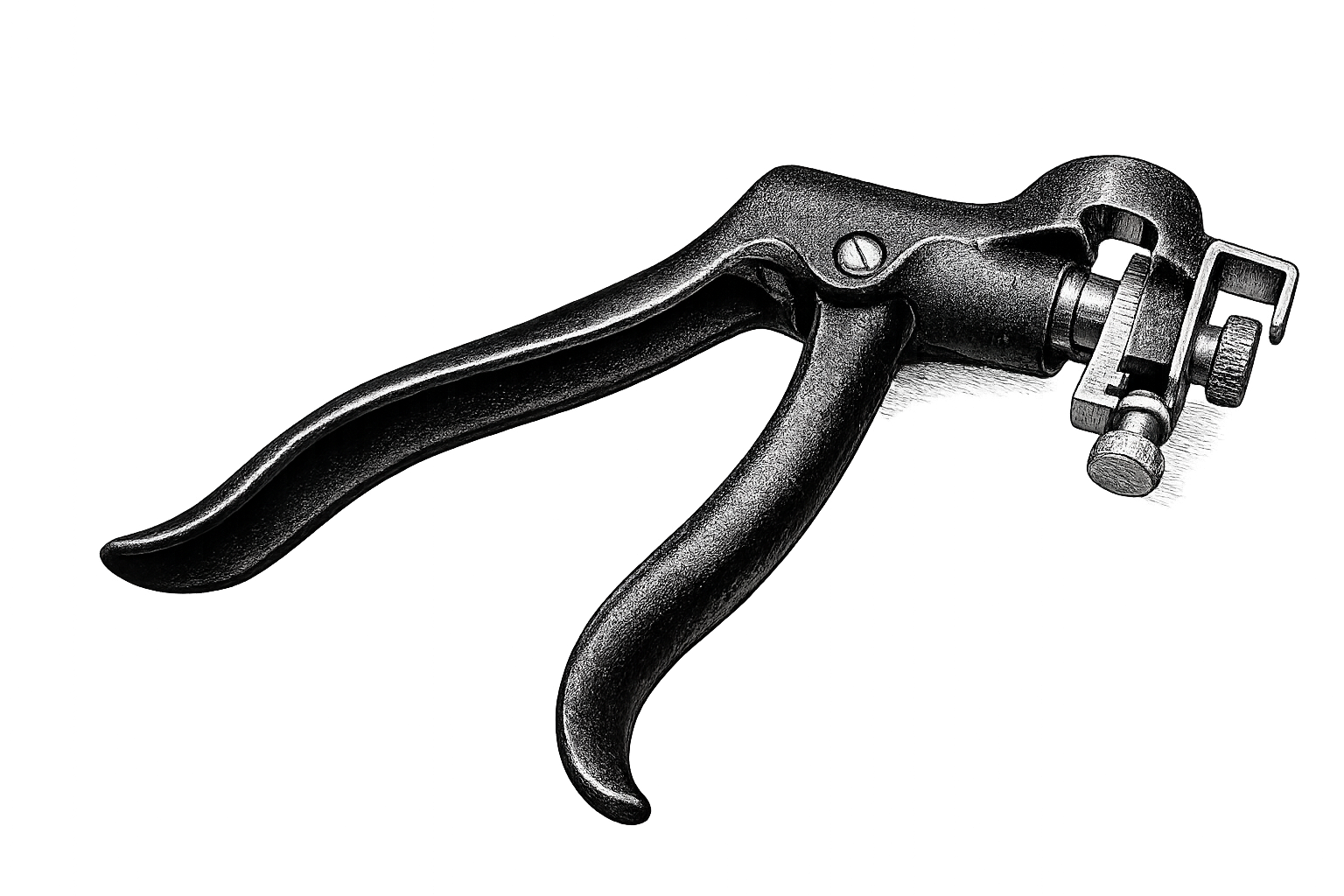
The Stanley 42X is one of the most common practical saw sets you'll find used today, and most people who buy one are figuring out how to use it from scattered forum threads and a one-page instruction sheet from the 1940s. Stanley's original directions are concise to the point of mystery, and the existing online how-tos tend to assume you already know what you're doing. This piece is the operating manual I wish came with mine.
The companion piece, The Practical Guide to Vintage Saw Sets, covers why the 42X is the right choice and how to evaluate one before you buy. This piece assumes you already have one — or you're about to — and you want to know how to use it.
Stanley's original scanned 42X instructions at the Vintage Saws library are the historical primary source, and they're worth a look. Brent Beach's saw setting page is also a good technical orientation. What follows is my own workflow, with notes where I've found Stanley's original guidance to need refinement in practice.
Know your tool
The 42X has fewer parts than it looks like it has. The main components:
The body is the cast iron frame that everything mounts to. The fixed handle is the grip you hold steady; the movable handle is the lever you squeeze. Inside the body, the hammer is the part that actually drives the tooth.
The anvil is the angled face on the front that the tooth bends against. It's adjustable vertically — that's the only adjustment that matters in normal use. The adjuster screw on the bottom moves the anvil up and down. The locking knob (a knurled nut on the front of the body) locks the anvil at its current height once you've set it.
The plunger is the small piston in the middle of the front opening. It pre-loads the saw plate firmly against the anvil before the hammer strikes — Stanley called this part a "bushing." The plunger is unique to the 42X; the plain Stanley 42 doesn't have one, which is why the 42X produces more consistent results.
The anvil itself has small markings on its side. The smaller marks indicate less set (anvil higher, less of the tooth gets bent). The larger marks indicate more set (anvil lower, more of the tooth gets bent).
The 42X is one of four similar Stanley saw sets. The plain 42 looks like a 42X but lacks the plunger. The 42W and 42SS use a different anvil arrangement with a marked dial in the front. The 43 is a larger version designed for very coarse teeth. This piece is specifically about the 42X — the others work similarly but the details differ.
Cleaning up a flea-market 42X
Many 42Xs you'll find used are not turn-key. They've spent decades in a drawer or a toolbox, the oil has gummed up, and the moving parts have seized. Before you use one, expect to spend an hour cleaning it up.
The most common issue is a seized locking knob. The knurled nut on the front won't turn. Soak it with a quality penetrating oil — PB Blaster or Kroil are the usual recommendations — and let it sit overnight. Work it gently the next day. Don't crank on it.
Once the locking knob is free, the adjuster screw on the bottom usually loosens up the same way. The two work together — the adjuster moves the anvil, the locking knob holds it in place.
A gunked plunger is the next common issue. If you squeeze the lever and the plunger doesn't snap back smoothly, it's clogged with old oil and rust. To clean it: tap the small retaining pin out of the back with a finish nail or a thin punch, work the plunger assembly out, clean everything with mineral spirits or a similar solvent, dry it, apply a light film of oil, and reassemble. The pin goes back in the same way it came out.
Surface rust is cosmetic. Steel wool and oil clean it up. Don't strip the original finish trying to make a flea-market 42X look new — patina is fine.
What can't be fixed: a cracked casting, a deeply worn anvil face, mangled threads on the adjuster or locking knob. If you see any of those, the tool is a parts donor at best.
Adjusting the 42X for the saw you're working on
Before any teeth get set, you set up the tool for the saw in front of you.
Identify the PPI of the saw — points per inch, counted along the tooth line. A typical user crosscut handsaw runs 8 to 10 PPI. A rip saw is coarser, usually 5.5 to 7 PPI. A backsaw is finer, 12 PPI on up.
Loosen the locking knob (the knurled nut on the front).
Turn the adjuster screw (bottom) to move the anvil. Up means less of the tooth gets bent — less set. Down means more — more set. Read the markings on the side of the anvil; the small marks are for fine work, the larger marks for coarser teeth.
For a typical user crosscut handsaw at 8 to 10 PPI, start at a middle marking and adjust from there. For a rip saw at 5.5 to 7 PPI, go to a larger marking. For a backsaw at 12+ PPI, go to a smaller marking.
To dial it in precisely, put the set on the saw as if you were about to set a tooth. Turn the adjuster screw until the edge of the anvil that the tooth bends over sits about a third to half of the way down from the tip of the tooth.
Lock the adjuster knob once you're satisfied. The knob holds the anvil at the height you've chosen.
Test on a single tooth before committing. This is the single most important habit in saw setting. Set one tooth, look at it, decide whether it's right. If the set is too heavy, move the anvil up. If it's too light, move it down. Repeat until one tooth comes out right, then set the rest of the saw. Saving yourself the work of resetting an entire saw at the wrong amount is worth the extra two minutes. Do your test on one of the last teeth at the heel of the saw, closest to the handle. Those teeth don't get used as much, so it matters less if you mess them up. And err on the side of too little set — it's easy to add more, but difficult to reduce.
Stanley published a table in the original instruction sheet recommending specific anvil positions for specific tooth counts. The table is a starting point, not a rule. The right amount of set depends on the wood you cut, the saw's purpose, and the kerf you want. Trust the test tooth over the table.
Setting the saw — the actual workflow
Clamp the saw in a saw vise with the tooth line up and as much of the plate above the jaws as the vise will hold cleanly. A real saw vise is ideal; any bench vise with hardwood jaw faces works.
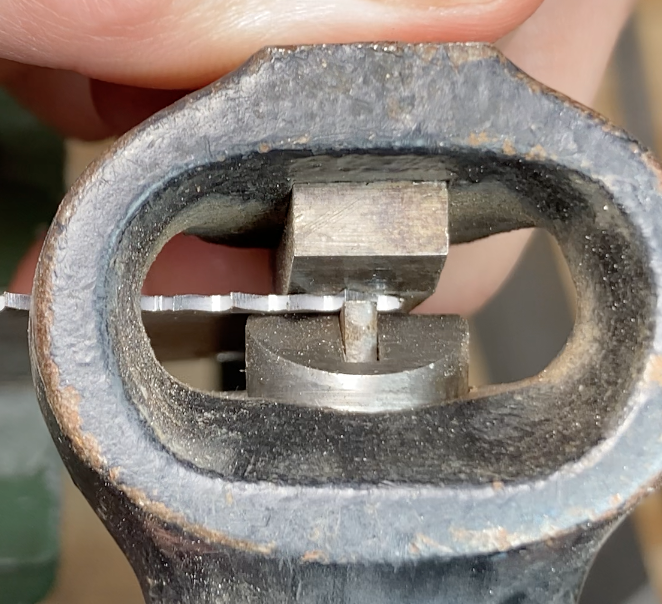
Position the 42X over the toothline, the hammer side facing the direction you want to bend the teeth. The fixed handle goes in your dominant hand, the movable handle in your fingers — the grip is the same as a pair of pliers. With your non-dominant hand, grip the locking knob between your thumb and forefinger. Rest the saw set on the teeth.
First pass: set every other tooth. Start at the heel of the saw (the handle end). Squeeze the lever firmly but not aggressively, lift the 42X off the teeth (don't slide it), move forward by two tooth positions, repeat. You're setting only the teeth that bend toward your dominant side; the alternating teeth get skipped on this pass.
The movable handle has a return spring. Let it return on its own between squeezes — don't pump it. Working in a steady rhythm gives more consistent results than working fast.
Work the entire length of the saw, then stop. Look at what you've done. The teeth you set should all be bent the same direction; the alternating teeth should still be in line with the plate.
Second pass: flip the saw, set the other half. Loosen the vise, flip the saw end-for-end, retighten. The teeth you skipped on the first pass are now positioned to be set on this side. Work down the entire length again, same rhythm, same pressure. When you're done, every tooth is set — alternating left and right down the line.
A few habits to build in:
- Don't squeeze hard. The 42X is designed to do the work with firm but moderate pressure. If you're cranking on the lever, something is wrong — usually the anvil position.
- Pause every six inches and look. It's surprisingly easy to lose track of which teeth you've set, especially on long rip saws.
Common mistakes
Squeezing too hard. Firm, even pressure is enough. If you're forcing it, stop and check the anvil and plunger.
Setting the wrong teeth. Easy to lose track on a long saw. Pause and look every six inches.
Skipping the test tooth. Always set one tooth first and look at it before committing to the rest. The two-minute test tooth saves the hour of re-setting an entire saw.
Over-setting. If a saw isn't cutting well, the problem is almost never that it needs more set. More likely: the teeth need filing, the plate is bent, or the saw is being pushed too hard. More set rarely improves anything.
Setting a saw that doesn't need it. A saw that cuts straight and doesn't bind doesn't need to be re-set just because you're sharpening it. Filing alone is enough most of the time.
Verifying your work
Once the saw is set, check the result before you call it done.
Look down the toothline from the heel. The teeth should alternate cleanly — left, right, left, right — with the set even on both sides. Any tooth that stands out as obviously different needs attention. If a tooth has too much set, dress the side with a mill file. Not enough set — set the tooth again.
The cut test. A well-set saw tracks straight, doesn't bind, doesn't wander. If it pulls one direction, the set on that side may be heavier. If it sticks in the kerf, the set isn't enough.
After setting — what comes next
Setting is one step in a three-step sharpening process. Setting bent the teeth outward; filing comes next, and that's where the cutting edge actually gets restored. A set but unfiled saw is no sharper than it was before — the teeth are just splayed.
Filing is its own subject. Pete Taran's Saw Filing Treatise at Vintage Saws is the canonical practical reference, and there's no point in me re-writing what he's already done well. Read it before you file.
If filing seems like more than you want to take on right now, that's fair. Send it to me and I'll get it fixed up for you.
Where to start
If you need a 42X or another saw set, I usually have some in stock. The companion piece, The Practical Guide to Vintage Saw Sets, covers the broader landscape of what to buy and what to avoid. And the sharpening service is always there if you'd rather have the work done.
Aaron, Shopkeeper and Saw Doctor, Bench & Chisel
References
Stanley Pistol Grip Saw Set No. 42 Directions. Stanley Rule & Level Plant, scanned at the Internet Archive.
Stanley 42X scanned directions at the Vintage Saws library. The original instruction sheet that came with new 42Xs.
Saw Filing - Setting, Brent Beach. Detailed technical orientation to the 42X mechanism and use.
Vintage Saws' Saw Filing Treatise, Pete Taran. The canonical practical reference for filing handsaws.
The Saw Set Collector's Resource (archived). Context for the 42X in the broader saw set landscape.
The Practical Guide to Vintage Saw Sets — companion piece on saw set selection and evaluation.
Vintage Saw Glossary — terms used throughout this guide are defined here.