Someone handed you a saw, or you found one at an estate sale, or it came out of a barn cleanout and you're not sure what you've got. That's the situation this page is for. Not "I want to deep-dive the complete catalog history of Henry Disston & Sons" — there are better resources for that — but the more immediate question: what is this saw, who made it, and is it worth holding onto?
The scholarly foundation for antique handsaw identification already exists, and I want to point you to it before we go any further. Erik von Sneidern's Disstonian Institute is the definitive reference for Disston saws — medallion variants, model histories, catalog reproductions, all of it. Pete Taran's Vintage Saws library is the best general primer on Western handsaw sharpening and history. Bob Summerfield's Handsaw Medallions and Escutcheons is the closest thing we have to a comprehensive medallion identification guide. These are the right tools when you want to go deep on a specific saw.
What I'm doing here is something different: a practical first pass for someone who picked up a saw and doesn't know where to start. I'll walk through the four most common saws you're likely to encounter — Disston, Warranted Superior, E.C. Atkins, and the honest "I don't know who made this" category that covers more saws than people realize — and give you a method for reading what the saw is telling you.
This page covers panel saws and hand saws primarily. Backsaws (tenon saws, carcase saws, dovetail saws) follow the same general identification logic, but they're a different conversation and I'll get to them separately. If you want general guidance on inspecting any antique saw for condition and usability, the Practical Guide to Buying Antique Handsaws covers that ground.
Start with the medallion
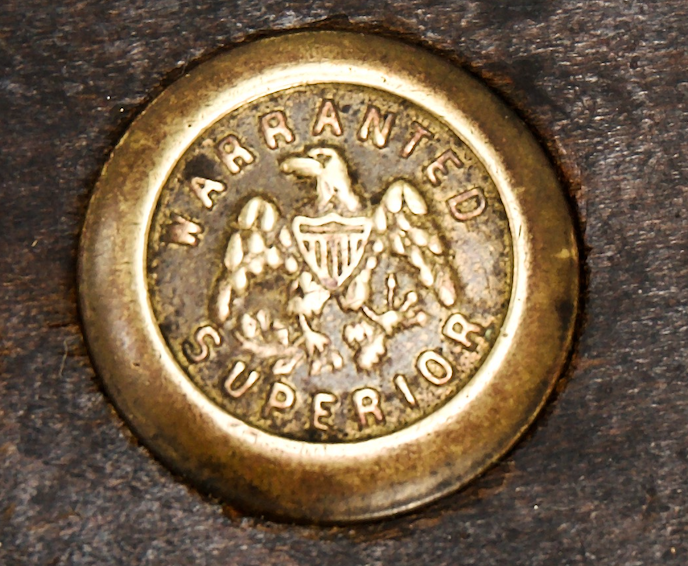
Warranted Superior
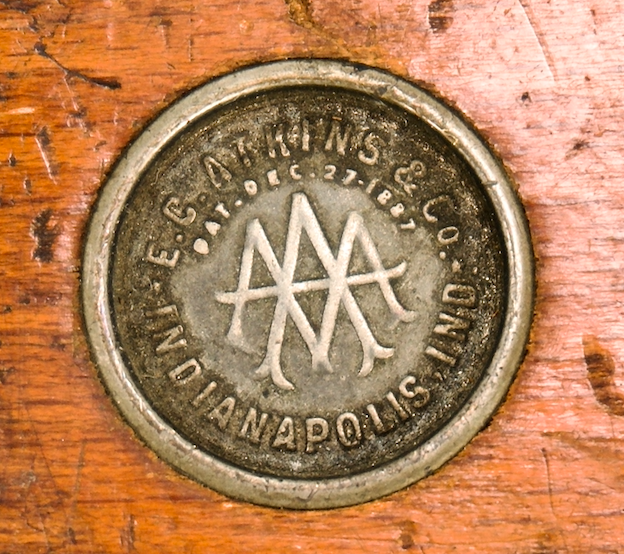
Atkins
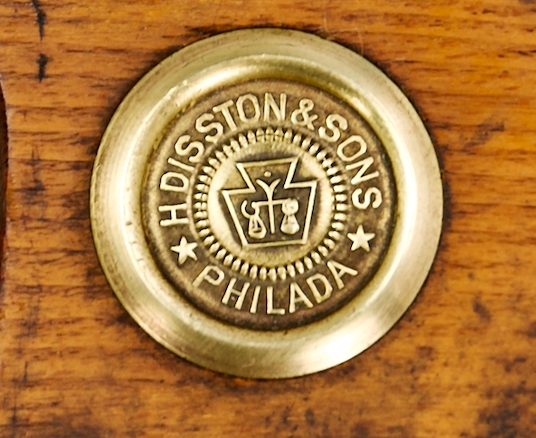
late 1800s/early 1900s
The medallion — the round brass disk on the handle — is usually the fastest identification path. On most American saws from the late 19th and early 20th centuries, the medallion carries the maker's name or at minimum gives you a strong clue about who made the saw and roughly when.
The first thing to do is look at it closely. Good light, ideally at an angle that picks up the relief details. If the medallion is corroded or caked with grime, a little oil on a cloth can often reveal enough detail to read without removing the medallion from the handle.
Is there a maker's name? Disston medallions are the most common you'll see and say "Disston" or "Henry Disston & Sons" or some variant thereof — the exact wording changed over the decades and is one of the better dating tools for that maker. Atkins medallions typically show the company name or their "AAA" triple-A trademark. Other named medallions you'll encounter: Simonds, Spear & Jackson, Harvey Peace, Richardson.
Does it say "Warranted Superior"? This is not a maker's name. It's a quality claim — roughly the 19th-century equivalent of "guaranteed." Dozens of manufacturers sold saws under the Warranted Superior label, and it tells you almost nothing about who made the saw on its own. More on this below.
Is it blank, missing, or illegible? A missing medallion isn't necessarily a problem — medallions were sometimes replaced, lost, or simply fell off on saws that weren't well-maintained. A blank medallion (no name, just a decorative design) is common on older saws and lower-grade hardware store saws. Prior to the use of medallions on saw handles, larger saw nuts were sometimes used where you would usually find a medallion on a saw handle. These large brass discs are called blind medallions and indicate the saw is old by American standards.
One important caveat: medallions can be swapped. A later medallion on an older handle, or a Disston medallion on a non-Disston saw, isn't unheard of. The medallion is a starting point, not the final word. Cross-check it against the etch and the handle to see if the story holds together.
Read the etch
Warranted Superior
Atkins
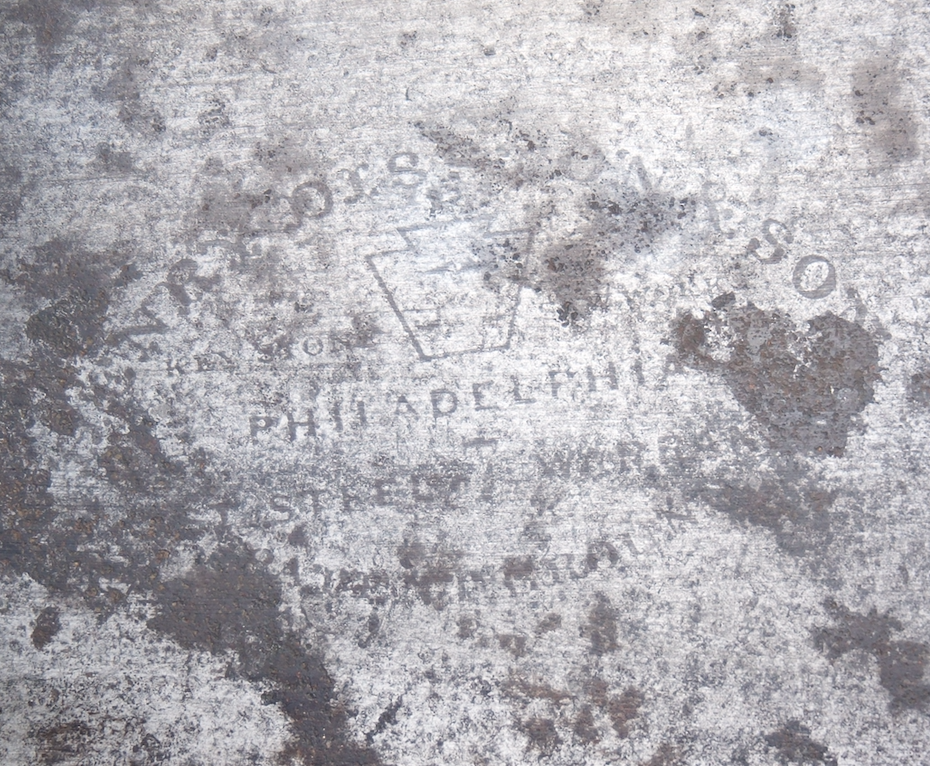
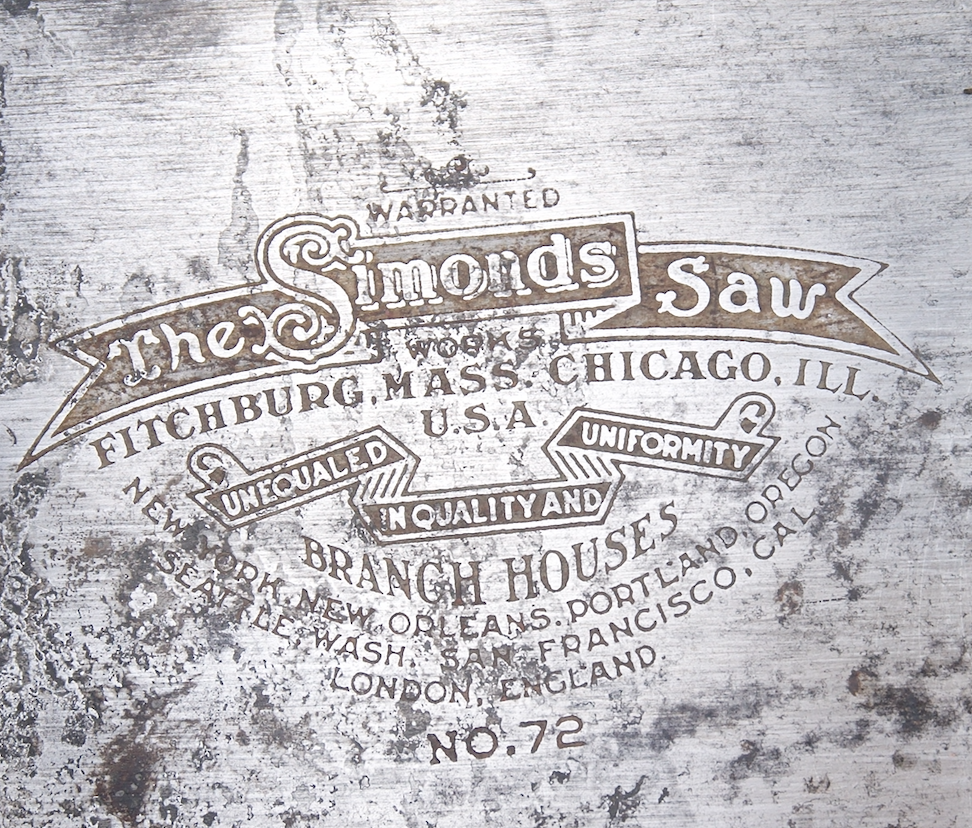
The etch is the design on the blade — typically at the center, on the "show" side of the plate. On a Disston, it's usually the keystone logo and the model name. On an Atkins, look for "E. C. Atkins & Co." and the AAA mark; their higher-grade Silver Steel line has "Silver Steel" etched plainly on the blade and Atkins was emphatic that any saw without that etch isn't a genuine Silver Steel saw. On Warranted Superior saws, you’ll usually find an etch for a hardware dealer. Hardware stores custom ordered saws from saw manufacturers like Disston that came with a Warranted Superior medallion and a custom etch.
A strong, readable etch narrows your identification considerably. A faded or absent etch — common on saws that have been heavily cleaned, used hard, or stored badly — doesn't make the saw less useful, but it does make it harder to identify precisely. If the etch is gone, shift your attention to the medallion and handle.
Some etches give hints as to the quality of the saw. For example, etches can proudly state the steel type (e.g., "Spring Steel," "London Spring," or "Patent Ground").
A note on etches and cleaning: I've seen a lot of saws where someone has gone after the rust aggressively with wire wheels or sandpaper and removed the etch entirely in the process. Light rust on the plate is not a problem and cleans up with a lubricant, abrasive and proper technique without hurting the etch. If you're working on a saw and the etch is still partially visible, treat it carefully — once it's gone, it's gone.
The handle tells a story
Disston
Atkins Perfection
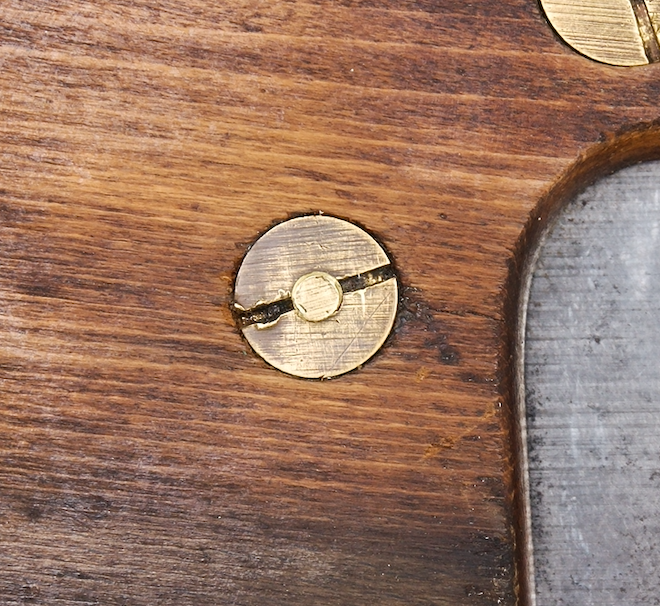
Split Nut
The handle shape, wood species, and hardware are all identification and dating cues, and collectively they're often more reliable than the medallion on saws where the medallion is missing or suspect.
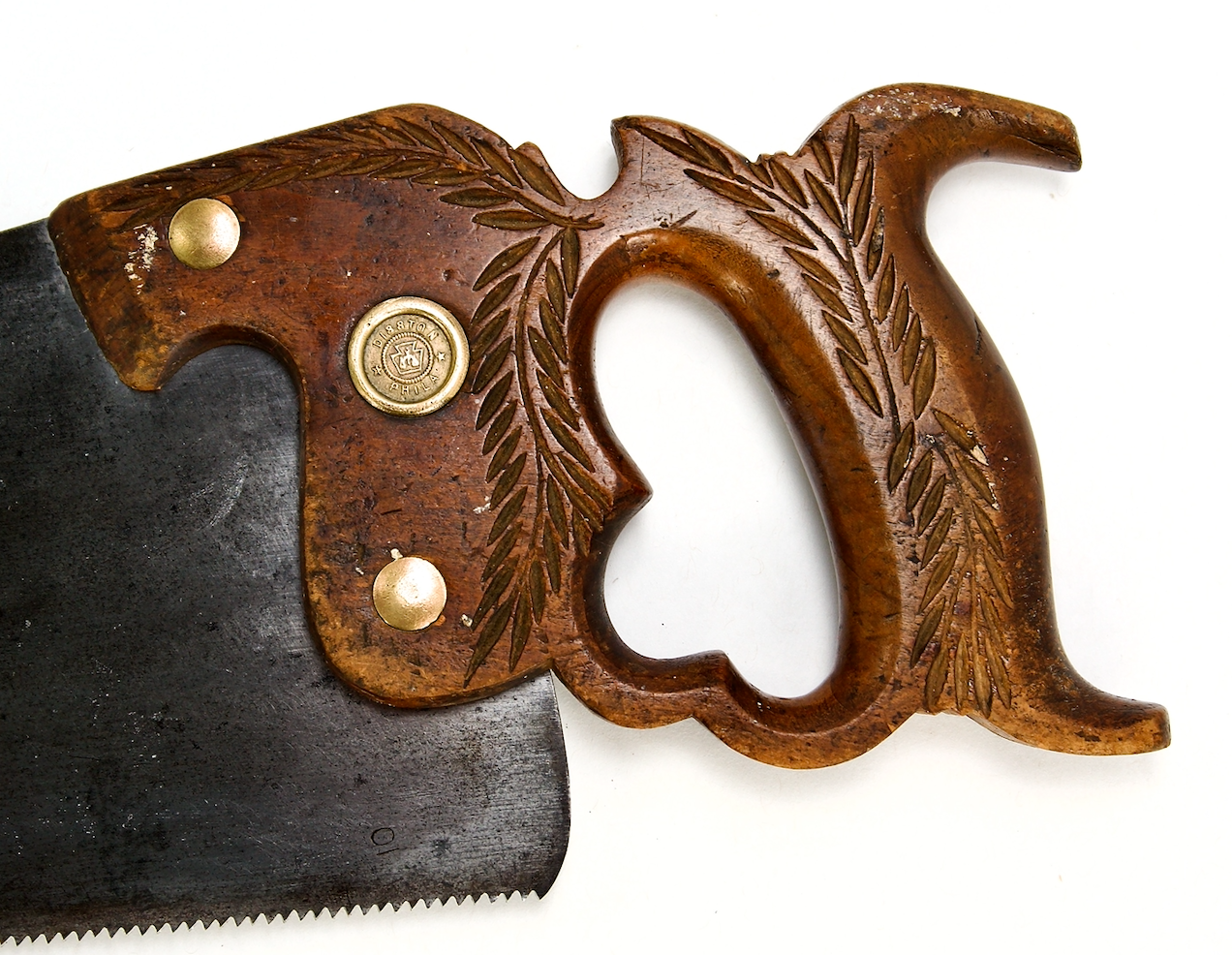
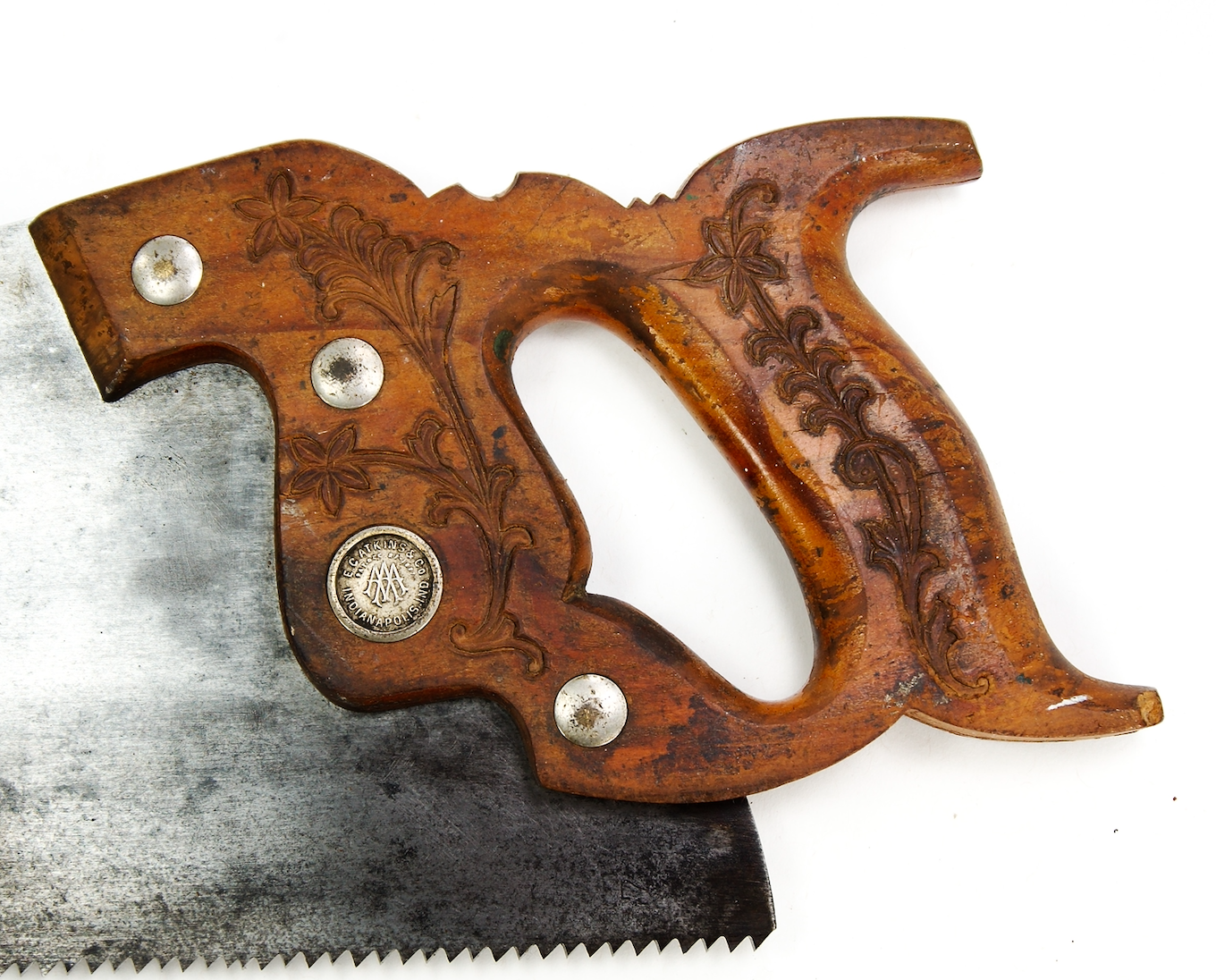
Handle shape. American handsaw handles evolved through recognizable styles over the 19th and early 20th centuries. Very early saws (pre-Civil War) tend to have more decorative features or flourishes. Atkins introduced what they called the "Perfection Pattern" handle — a more ergonomically angled grip that became their signature — and marketed it as a distinct advantage over the "old style straight across" handle. By the mid-20th century, handles had generally become plainer and more utilitarian.
Wood species. On American saws, applewood was the prestige choice for handles on higher-grade saws. Beech was used for mid-grade and later production. Atkins used applewood on their No. 53, No. 400, and other top-line saws. Disston used applewood on their No. 8, No. 12, and other premium models, and beech on the more common grades. If you have a saw with a handle that's held up beautifully over a century, there's a decent chance it's applewood — it's a dense, hard fruitwood that ages very well.
Hardware. The saw nuts — the nuts that fasten the handle to the blade — changed in style over the decades and are another dating reference for Disston specifically. Split nuts - A specialized saw nut with a slot across the head, where used on most saws made before roughly 1875. Removing them without damage requires a fitted screwdriver. Saws with split nuts are generally older and higher-value. The number of fasteners also matters: a three-screw handle vs. four-screw, the presence or absence of a decorative medallion. Higher-grade Atkins saws used brass screws and a medallion; their catalog is specific about this.
Signs of replacement. A mismatched handle — older style handle with a newer medallion, or a clearly amateur replacement in the wrong wood — means the saw can't be accurately dated by the handle alone. It also means the saw is "not original" in collector terms, though it may still be an excellent user.
The four saws you're most likely to find
Disston
Disston is the most common named antique handsaw on the American market, and for good reason — Henry Disston started making saws in Philadelphia in 1840 and by the late 19th century the company was the largest saw manufacturer in the world. There are a lot of them out there.
The Disston identification path is well-documented enough that I'd point you to the Disston Buyer's Guide I've written and to the Disstonian Institute for anything specific. The short version: the medallion text changed across well-documented eras (from "Henry Disston & Son" in the 1860s through various "Disston & Sons" and eventually just "Disston" medallions), the keystone etch is the signature visual. Any clean Disston from roughly 1876 into 1940s is likely to be an excellent user saw.
Warranted Superior
"Warranted Superior" is a generic brand, not a maker — something a lot of people get wrong when they're first looking at antique saws. The phrase dates to 19th-century British trade practice and was picked up by American hardware importers and manufacturers. Dozens of different makers produced Warranted Superior saws, selling them through hardware stores under that label rather than their own name.
Disston made a significant number of Warranted Superior saws — their lower-priced line sold through hardware-store channels. A Disston-made Warranted Superior is typically identifiable by the handle shape and hardware, which mirrors contemporary named Disston production. The plate quality is usually the same steel; these were genuine Disston saws just sold under a different label.
Other Warranted Superior saws came from Sheffield makers, from other American manufacturers, and from sources that are now essentially untraceable. The quality range is wide. A well-made Warranted Superior — good plate, clean teeth, solid handle — is often a better buy than a named-brand saw in mediocre condition. An unknown-maker Warranted Superior in rough shape is just a rough saw.
E.C. Atkins
Atkins is the second-most-common quality American handsaw maker you'll find in the wild, and they're consistently undervalued relative to Disston — probably because the collector scholarship is thinner. The company was established in Indianapolis in 1857, incorporated in 1885, and by the 1910s had branch houses across the country and a Canadian factory in Hamilton, Ontario.
The identification markers are consistent across their catalog. Look for "E. C. Atkins & Co." etched on the blade, usually alongside the "AAA" triple-A trademark. Their higher-grade "Silver Steel" line carries the words "Silver Steel" explicitly on the blade; this was their branded steel formulation, which they marketed as comparable in quality to fine razor steel. The Damaskeen finish — a distinctive surface treatment — is mentioned throughout their catalog.
Atkins handles on higher-grade saws are applewood with what they called the "Perfection Pattern" — a handle angled to direct cutting force more directly onto the teeth, which they contrasted with the "old style straight across" handle. Their flagship hand saw was the No. 400, called "The Four Hundred," their equivalent of the Disston No. 12. The No. 53 and No. 65 were their strong mid-grade offerings.
An Atkins in good condition is a very good saw. I find them underpriced relative to comparable Disstons, and I think that's a buyer's opportunity.
Unknown maker
This category covers more saws than people expect. A lot of antique saws in the wild simply can't be positively identified — Warranted Superior saws from unknown manufacturers, hardware-store private-label saws, saws where the medallion is gone and the etch is worn away, Sheffield imports that predate consistent marking practices.
Bob Summerfield's medallion reference is the best tool for attempting identification on saws with a readable medallion that doesn't correspond to a known maker. Beyond that, the handle style, hardware details, and plate quality can sometimes narrow things down, but often the honest answer is "I don't know who made this."
What the plate actually tells you
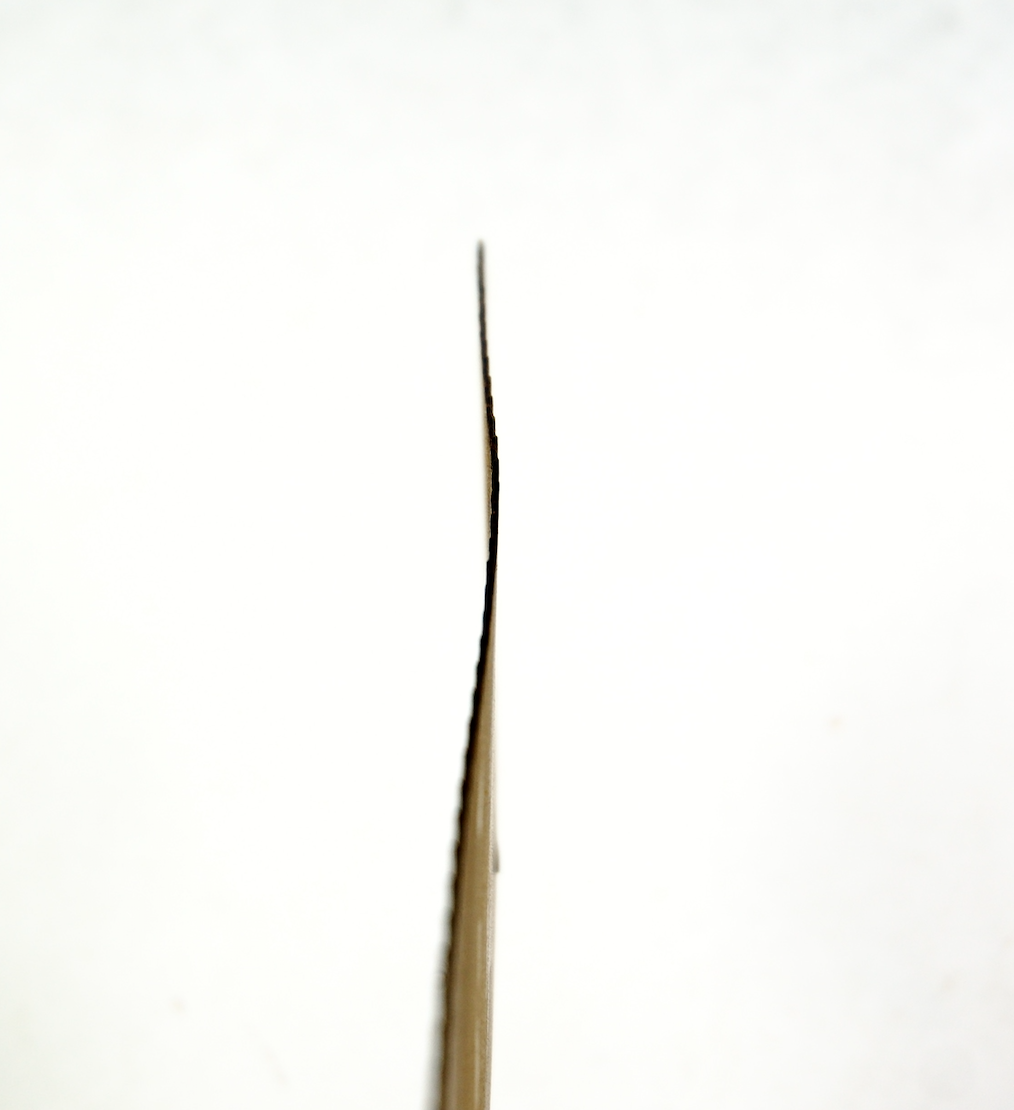
Kinked saw blade
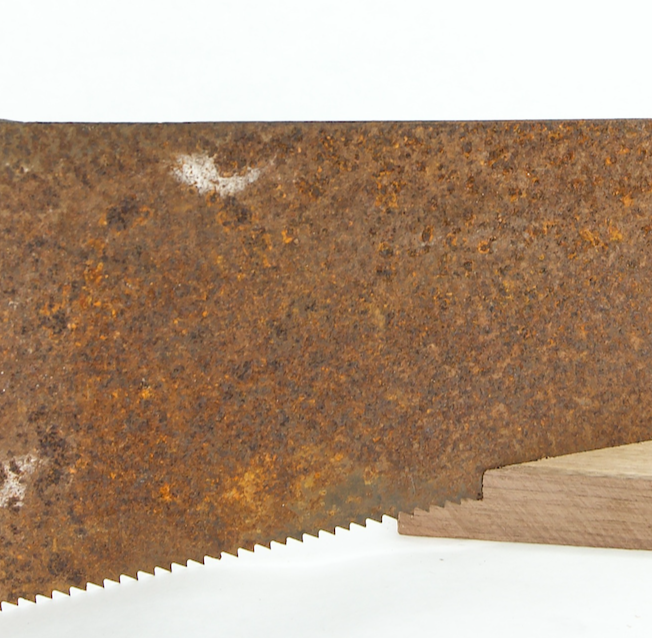
Heavy rust
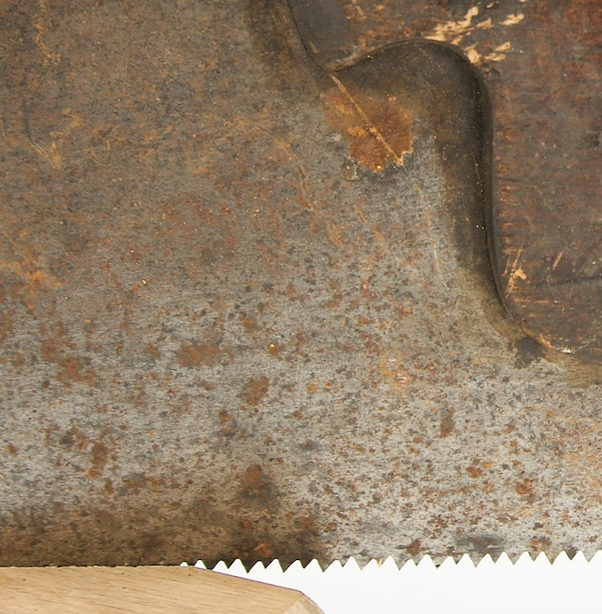
Light surface rust
Regardless of who made the saw, the plate condition is the most important factor for usability — and it's something you can evaluate without knowing anything about the maker.
Sight down the toothline. Hold the saw up and look along the teeth from the handle end, the way you'd check a board for straightness. A gentle, even bow is normal and can usually be corrected. A sharp kink — a sudden deviation at one point — is harder work. A plate that wanders in multiple directions is a significant project, and I'd usually pass unless the saw has other compelling qualities.
Surface rust vs. deep pitting. Surface rust, the orange-brown kind that hasn't gone far into the steel, cleans up without damaging the plate. Light pitting — small divots from more advanced rust — is fine on a user saw; a hundred years of age earns some character. Deep pitting on or near the tooth line, where the steel is thin and the teeth are formed, is a real problem and limits how much life the saw has left in it.
How much plate is left. A saw that's been filed many times over its life will have a shorter tooth line than it started with. Look at the width of the plate near the toe — if it's noticeably narrower there than at the heel, the saw has been filed down significantly. There's a point where a saw has been filed enough that it's no longer worth sharpening.
For more detail on condition assessment, the Practical Guide to Buying Antique Handsaws covers what to look for when evaluating any saw for purchase or restoration.
A word on value
The pricing question — "is this worth anything?" — is one I get more than any other, and I want to be honest about how I think about it.
Maker matters less than condition for usability. A Warranted Superior in excellent, well-tuned condition often cuts better and is more pleasant to use than a famous-name saw that's been abused and improperly sharpened. If you're looking for a saw to use, don't let the name on the medallion override what the plate and teeth are telling you.
Condition matters less than maker for collector value. A pristine Disston No. 12 with a strong etch will attract collector interest that a comparable Atkins won't, not because the Atkins is a lesser saw, but because the collector scholarship and community for Disston is more developed.
Where you buy also matters. Estate sales and barn finds typically yield the best prices if you're patient. eBay is the broadest market but the prices reflect that — you're competing with people across the country. A dealer who has already cleaned and sharpened the saw is selling a different product than a rough saw at a flea market; the premium reflects the work that went in.
If you've found a saw and you're wondering what it's worth on the market, the best current reference is eBay's completed listings — search the specific saw and filter to "sold" items to see what has actually changed hands, not just what sellers are asking.
Where to start
If you've identified your saw and want to read more about a specific maker, the Disston Buyer's Guide goes deep on Disston identification and evaluation. The Vintage Saw Glossary is useful for terminology you encounter throughout this kind of research.
If you'd rather skip the hunting and buy something identified, cleaned, and ready to use, the Warranted Superior, hand and panel saw, and E.C. Atkins sections of the shop have what I currently have in stock. Everything there has been evaluated, cleaned, and sharpened or sold as-is with an honest description.
If you found a saw with good bones but it needs sharpening and you'd rather not do the work yourself, the saw sharpening service is there for that.
Aaron, Shopkeeper and Saw Doctor, Bench & Chisel
References
The Disstonian Institute, Erik von Sneidern. The definitive online reference for Disston handsaw identification, dating, and cataloging. The right tool for precise model identification and medallion dating.
Vintage Saws, Pete Taran. The canonical practical primer for Western handsaw sharpening and general saw history.
Handsaw Medallions and Escutcheons, Bob Summerfield (2023 edition). The most comprehensive medallion identification reference available — covers American, British, and international makers. Available as a free PDF download.
E.C. Atkins & Company, Catalog No. 18 (1919). Primary source for Atkins model designations, materials, and product descriptions. Available via the Internet Archive.
E.C. Atkins & Company, Saw Sense (1948). Atkins dealer reference booklet covering Silver Steel product line, construction, and sharpening guidance.
A Practical Guide to Buying Antique Handsaws — general criteria for evaluating any antique handsaw for condition and usability.
Disston Buyer's Guide — Disston-specific identification, dating by medallion era, and model guide.
Vintage Saw Glossary — terminology used throughout this and other reference pieces on the site.