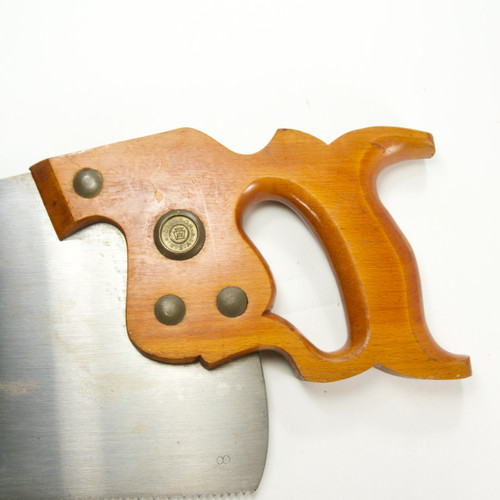


This Disston D-8 came from Pete Taran's personal collection — a pre-1928 blade (the "8" sits inside the D on the etch) paired with a replacement handle and medallion from the early 1950s. It's a 7 PPI rip saw: finer than most rip saws, so it starts easier and cuts a bit less aggressively while still ripping efficiently.
At a glance
| Maker | Disston |
| Model | D-8 |
| Approximate era | Blade pre-1928; handle & medallion replacement, ca. 1947–1953 |
| Length | 26 inches |
| Plate | 7" at the heel, 2-1/2" at the toe, tapered (skew back) |
| Points per inch | 7, rip |
| Handle | Replacement, thumbhole grip pattern (not original to this blade — see condition notes) |
| Medallion | Nickel-plated, ca. 1947–1953 (replacement) |
| Etch | Faint but readable |
| Sharpened by Aaron | Yes — ready to cut |
What I did to it
- Disassembled and inspected. Every part came off the saw and was checked before cleaning.
- Cleaned to preserve character. Handle and hardware were cleaned in a way that keeps the saw's age visible — no over-polishing.
- Plate cleaned. Cleaned properly while preserving the etch.
- Jointed and shaped. Toothline jointed and refiled for rip work.
- Sharpened to 5° rake, 0° fleam. Standard general-use rip geometry.
- Set. Minimum set applied — just enough to let the plate glide in the kerf without binding.
Honest condition
This saw has a replacement handle. Take it off and you can see the extra holes drilled to fit it to this blade. There's one missing tooth; the rest are in good shape, so I sharpened around it rather than retoothing, which is my standard call when a saw's down a couple of teeth and everything else checks out. Etch is faint but readable. No other issues — this is a solid user saw.
About Disston
Henry Disston founded the company in Philadelphia in 1840, and by the late 1800s Disston was the largest saw maker in the world — the standard against which every other maker was measured for nearly a century. The D-8 was Disston's everyday professional-grade hand saw, built for the carpenters and cabinetmakers who used them daily — not the same tier as the No. 12, but solid, working-grade construction.
Who this saw is for
The woodworker who wants a rip saw with a higher PPI than usual. At 7 points, it's easier to start and cuts less aggressively than a typical coarse rip saw, while still ripping efficiently. A good saw to put to work.
Questions about this saw? Email me at aaron@benchandchisel.com — I answer them all.
— Aaron, Bench & Chisel