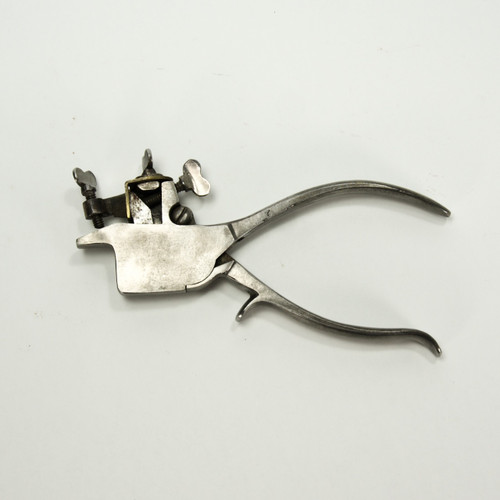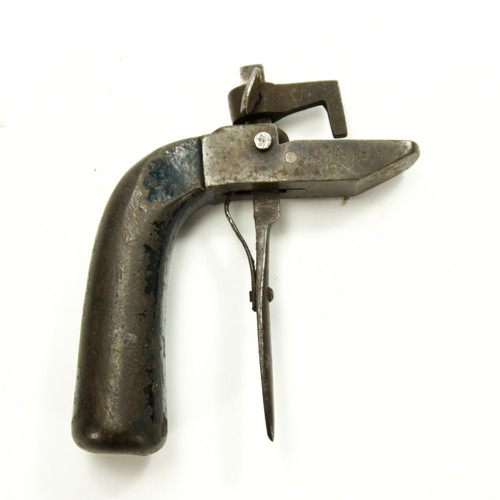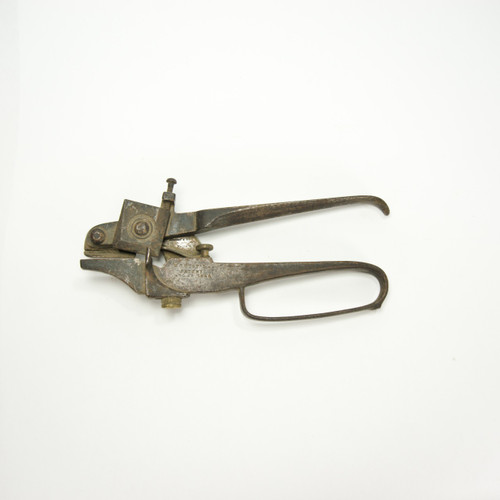


This is a Cook's Patent hammer saw set, made under U.S. Patent No. 145,724, granted December 23, 1873. The mechanism works, and I don't see many of these.
At a glance
| Type | Saw set, hammer style |
| Maker | Cook's Patent |
| Patent | U.S. No. 145,724, December 23, 1873 |
| Patentee | Roswell F. Cook, West Potsdam, New York |
| Action | Lever-cocked hammer, spring-driven |
| Condition | Mechanism works; aged surface; stamp worn |
From the bench
The mechanism works. I haven't tested it on a saw, so I'm not promising how it sets any particular blade. The patent date is stamped on the frame, but the stamp is worn and shallow. The photos show it as it is.
How it works
Cook's patent describes a hammer and a lever that pivot together on a cast frame. Pulling the lever back raises the hammer and holds it there. A slight forward push on the lever releases it, and a spring drives the hammer down onto the tooth. The spring seats in notches in the frame, and moving it between notches changes how hard the hammer hits. The patent says the frame can be attached to a bench or made to be held in the hand.
About the patent
Roswell F. Cook of West Potsdam, New York, filed in October 1873 and received the patent that December. It claims a notched frame and lever combined with a hammer driven by an oscillating spring. Inventors patented almost 900 different saw sets between 1810 and 1925, and Cook's hammer set is one of them.
Who this is for
A collector of saw sets or hammer-style tools, or a saw sharpener who wants to try a period hammer set. It is not a proven saw set. I haven't tested it on a saw, so it suits a buyer who is comfortable trying it out.
Questions? Email me at aaron@benchandchisel.com — I answer them all.
— Aaron, Bench & Chisel